
Gravel Calculator for Driveway
A gravel driveway is built in layers: large base stone, a middle layer and a compactable surface. This calculator works out how much of each you need — in cubic yards and tons — from your driveway’s length, width and any turnaround or parking area, adds an allowance for compaction, and estimates the cost from the prices your supplier quotes.
- Free to use
- No sign-up
- Runs in your browser
Driveway gravel calculator
| Layer | Stone | Depth (in) | Density (tons/yd³) | Price per ton ($, optional) |
|---|---|---|---|---|
| Base | ||||
| Middle | ||||
| Top |
Driveway Gravel Project Pack
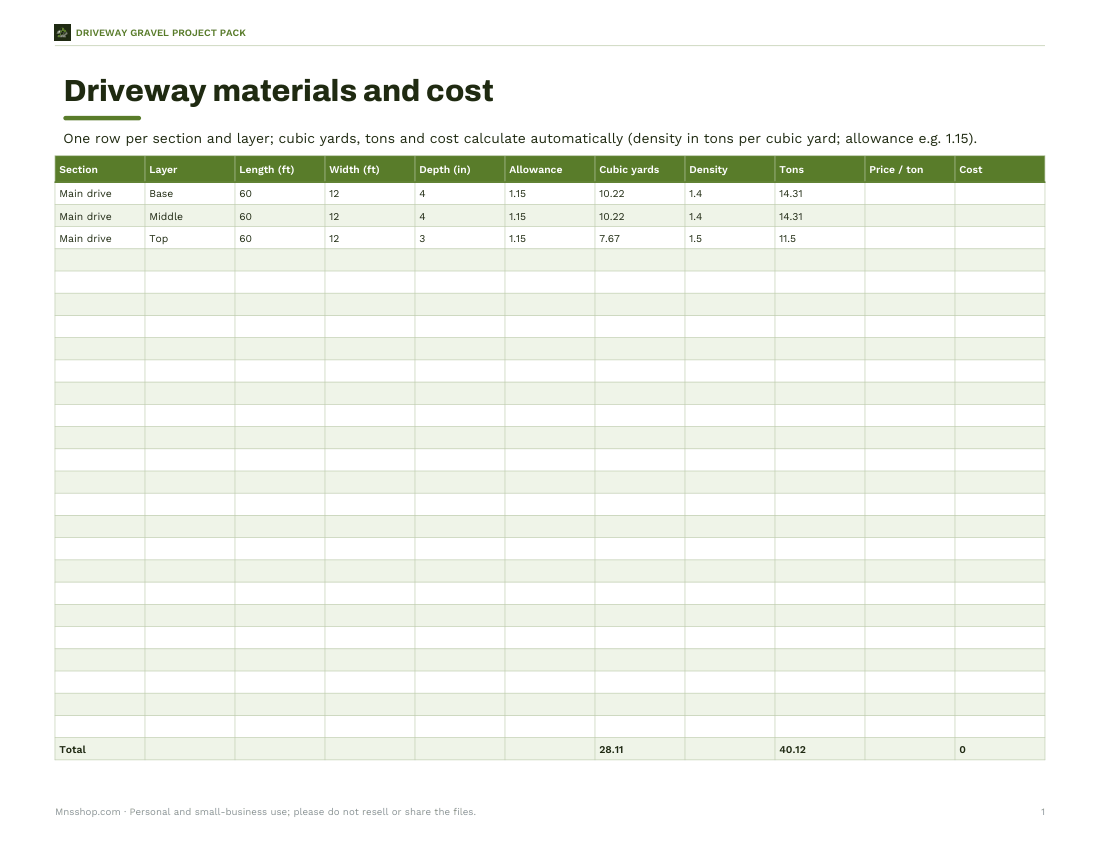
Excel driveway materials and cost worksheet, a printable layer diagram, a supplier quote comparison sheet and a driveway maintenance log.
- Materials worksheet (XLSX)
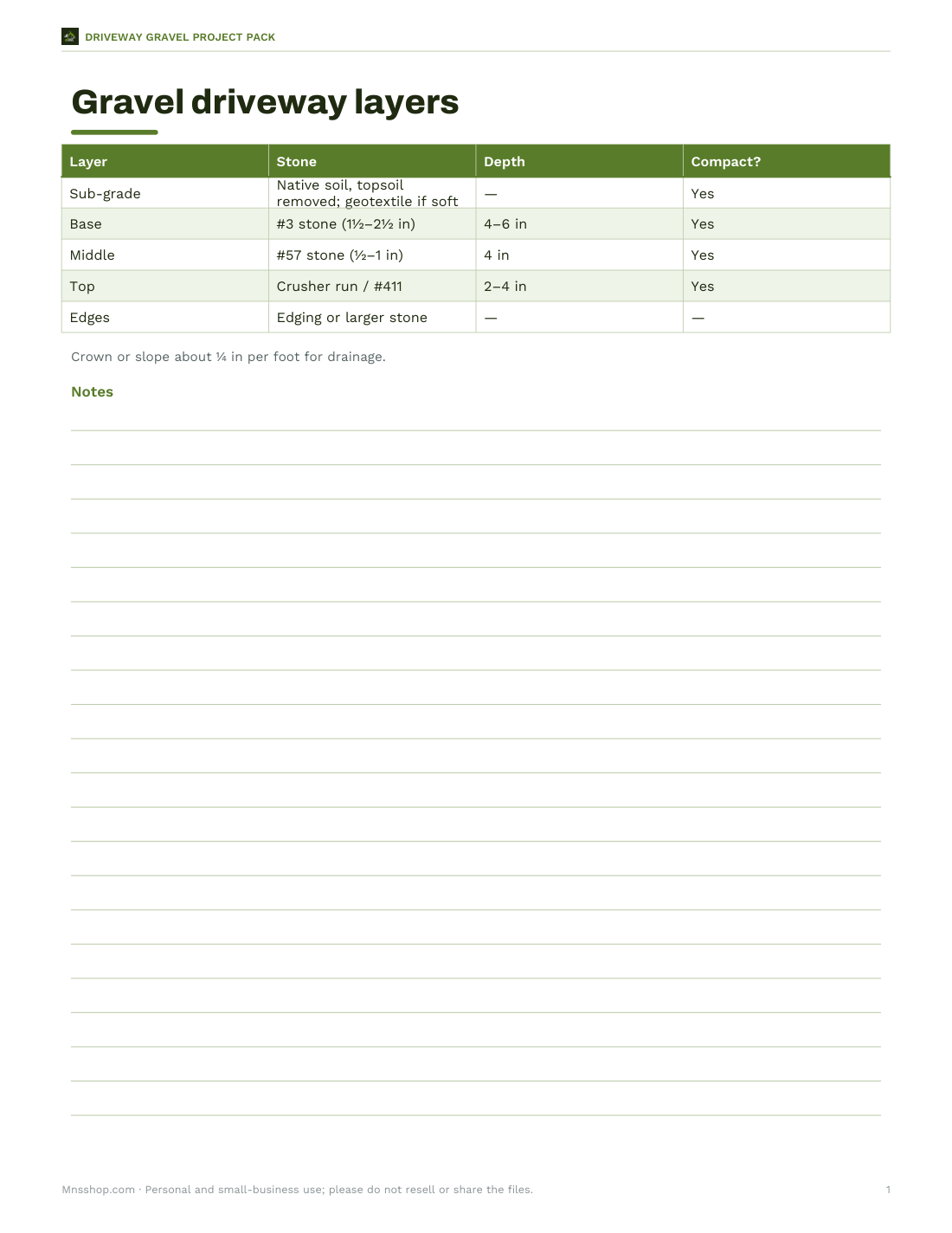
- Layer guide (PDF/XLSX)
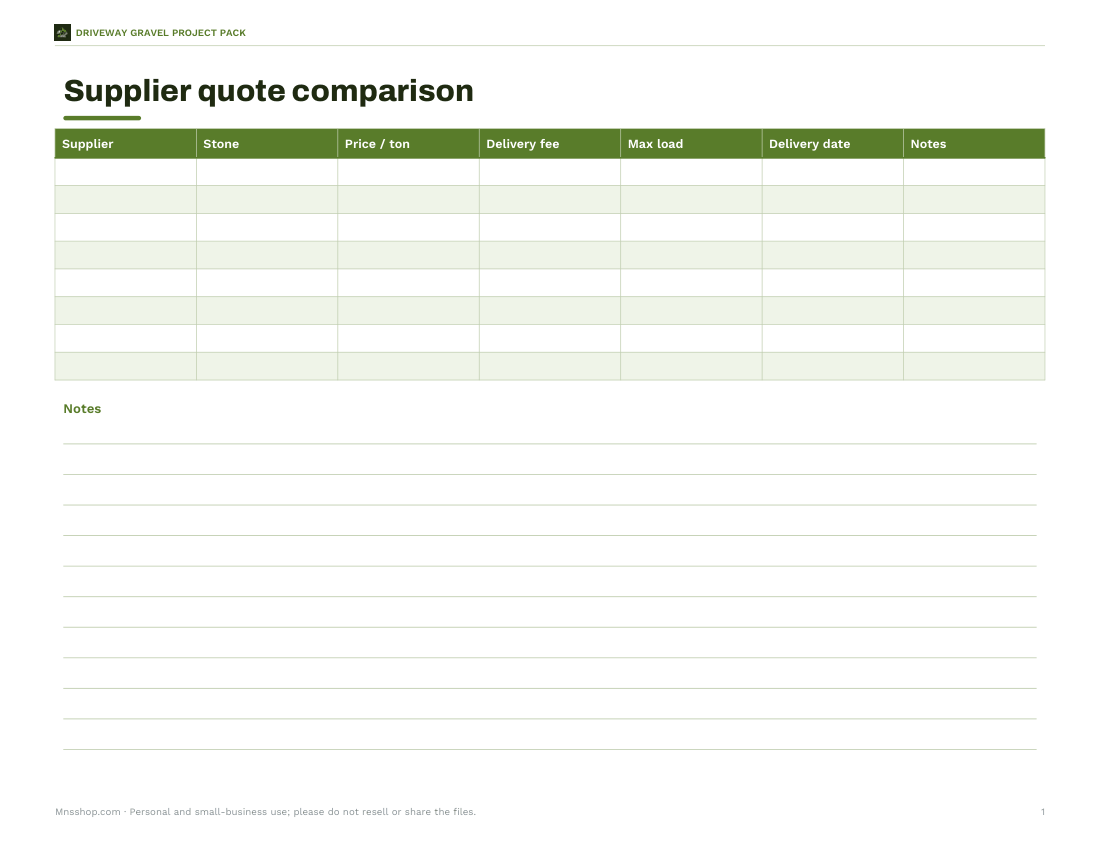
- Quote comparison (PDF/XLSX)
- Maintenance log (PDF/DOCX/XLSX)
Formats: XLSX, PDF, DOCX. Instant download after payment (link valid 72 hours, up to 5 downloads). AI-assisted: the templates were drafted with AI help and reviewed and laid out before publishing.
$5.00 USD, one-time 4 files · about $1.25 each
- Instant download
- 7-day refund
- Secure checkout by Stripe
7-day money-back guarantee. Full refund within 7 days of purchase, even after you download.
Free sample: Driveway Materials Worksheet (PDF, 57 KB)
Full refund within 7 days — see the refund policy and license.
Free printables
Single sheets you can print right now, no sign-up. The full pack adds every sheet in one download plus the editable files.
 Printable Driveway Gravel Materials Worksheet
 Printable Gravel Driveway Layer Guide
 Printable Driveway Gravel Quote Comparison
 Printable Driveway Maintenance Log
Driveway gravel layers
| Layer | Typical stone | Typical depth | Job |
|---|---|---|---|
| Base | #3 stone, about 1½–2½ in | 4–6 in | Spreads the load and drains water |
| Middle | #57 stone, about ½–1 in | 4 in | Locks into the base and levels it |
| Top / surface | Crusher run (#411, “dense grade”), or #57 / pea gravel for a decorative finish | 2–4 in | Compacts into a firm driving surface |
Stone names and numbers vary by region and supplier — the numbered sizes follow a common US grading system, but local quarries may call the same product “road base”, “MOT Type 1” (in the UK) or “driveway mix”. Describe the size you want and ask what they stock.
How the calculator works
- Area = length × width, plus any extra area for a turnaround or parking pad.
- Volume of each layer = area × depth (in feet): 4 inches is 4 ÷ 12 = 0.333 ft.
- Cubic yards = cubic feet ÷ 27.
- A compaction allowance is added, because loose stone settles when rolled or driven on — 10–20% is common.
- Tons = cubic yards × density. Crushed stone commonly weighs around 1.4 tons per cubic yard; crusher run with fines is often around 1.5 or more.
- Cost = tons × the price per ton your supplier quotes.
Worked example
| Layer | Depth | Loose volume | With +15% | Tons |
|---|---|---|---|---|
| Base (#3) | 4 in | 720 × 0.333 = 240 ft³ = 8.89 yd³ | 10.22 yd³ | 14.3 (at 1.4) |
| Middle (#57) | 4 in | 8.89 yd³ | 10.22 yd³ | 14.3 (at 1.4) |
| Top (crusher run) | 3 in | 180 ft³ = 6.67 yd³ | 7.67 yd³ | 11.5 (at 1.5) |
| Total | 11 in | 24.4 yd³ | 28.1 yd³ | about 40 tons |
A 60 × 12 ft driveway has an area of 720 sq ft. These are the default figures in the calculator; enter your own dimensions and supplier densities.
How deep should a gravel driveway be?
For a new driveway on soil, a total of about 8–12 inches of compacted stone in three layers is a common recommendation for cars; heavier vehicles, soft clay soils and wet sites may need more, plus a geotextile fabric under the base to stop stone sinking into the soil. For topping up an existing, well-compacted driveway, 2–3 inches of surface stone is often enough. Local conditions vary, so ask a local contractor or supplier if you are unsure.
Choosing the surface stone
- Crusher run — angular stone mixed with stone dust; packs hard and is the most practical driving surface.
- #57 stone — clean angular stone; drains well and stays put reasonably, but is looser underfoot.
- Pea gravel — rounded and attractive, but it rolls and migrates, so it needs edging and is harder to walk and drive on.
- Decorative stone — use over a compacted base, in a thin layer.
Building tips
- Remove topsoil and organic material before laying the base.
- Shape a crown or cross-slope so water runs off — about ¼ inch per foot is a common target.
- Compact each layer with a plate compactor or roller before adding the next.
- Install edging to keep stone in place, especially on curves.
- Plan for drainage at low points: culverts or ditches where water crosses the driveway.
- Keep some surface stone for topping up ruts and potholes.
Maintaining a gravel driveway
- Rake stone back into ruts and wheel tracks every few months.
- Top up the surface layer with an inch or two of crusher run every few years, or when the base starts to show.
- Keep drainage ditches and culverts clear so water doesn’t wash stone away.
- Fill potholes by cleaning them out, filling with stone and compacting, rather than just dropping stone on top.
- Control weeds early, by hand or with a suitable treatment.
Ordering and delivery
Quarries and landscape suppliers usually sell by the ton or by the cubic yard, and a delivery truck carries a set maximum load. Order a little more than calculated rather than less — a second delivery costs far more than a small surplus — and ask where the truck can tip so the stone ends up close to where it is needed. Bags are practical only for small repairs: one ton of stone is roughly forty 50-pound bags.
Driveway project pack
The optional pack includes an Excel materials and cost worksheet for multiple sections and suppliers, a printable layer diagram, a supplier quote comparison sheet and a driveway maintenance log. The calculator above is free to use.
AI-assisted content
This page was drafted with AI assistance and reviewed before publishing. Figures are estimates; densities and recommended depths vary with materials and site conditions.
Frequently asked questions
How much gravel do I need for a driveway?
Multiply area by depth for each layer, convert to cubic yards (÷ 27), add 10–20% for compaction and multiply by density for tons.
How many tons are in a cubic yard of gravel?
Typically about 1.4 tons for crushed stone; ask your supplier.
How deep should a gravel driveway be?
Often 8–12 inches of compacted stone in three layers for a new driveway.
What is the best gravel for a driveway?
Large base stone, a middle layer of #57, and crusher run on top is a common combination.
How many 50 lb bags are in a ton?
Forty.
Does the calculator include compaction?
Yes, choose an allowance from 0 to 20%.
Should I use landscape fabric under a gravel driveway?
A geotextile under the base is often recommended on soft or clay soils to stop stone sinking.